
Aftab
Ahmad Malik,
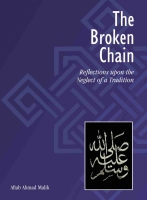
The Broken Chain
Reflections upon the Neglect of a Tradition
(Bristol: Amal Press, 2001), ix + 139 pp., £ 5:99
|
This review was published in Q-News, July 2001. Contact: info@q-news.com or visit www.q-news.com
|
Written as a guidebook for students at university, Malik addresses the key issues of the day. He examines how we now misconstrue decontextualised "information" mediated by print, audio-visual and digital technologies as true "knowledge", even though the latter should be an unveiling of our relation with Allah at the feet of pious scholars possessing an unbroken chain going back to the Prophetic origin. The author traces this secularisation of religious learning wherein Muslims imbibed the colonial critique of tradition (read "religion") as fixed and outdated, and cast it aside in the name of Progress. In social terms, this meant that a new Westernised elite took upon themselves the role of the authoritative interpreters of Islam and sought to exclude the `ulama. The work crucially highlights the need to accept one's own place within a religious hierarchy (which piety demands we always see as unsure) and to recognise the signs of piety and learning among those whom Allah has favoured. Malik points out that modern egalitarianism has everything to do with an unrestrained egotism or a tyranny of mediocrity that threatens to equate Islam with dull sloganeering, while hierarchy has nothing to do with unjust elitist exploitation but rather with the Divine decree that ranks humanity in the world and in the hereafter. To illustrate this thesis, Malik discusses the traditional veneration of the Prophet (s) in Islamic piety that is now so misunderstood. A couplet from a eulogy of the Prophet (s) that closes the work encapsulates the modern dilemma: "Upon you your ashiqs (lovers) lavish great praise/To those who do not understand, they simply dismiss this as a craze." Defiant in his right to do so but conciliatory in tone, Malik outlines the tradition of Prophetic praise from Hasan ibn Thabit (the poet of the Companions) onwards. A joyful witnessing that was once so uncontested now seems drowned out by an ugly dirge of carping criticism. Yet we would do well to heed the words of the contemporary mystic al-Shaghouri, "Those who would prevent love have no action/The forbidding of love is naught but sent from the Bestower of Gifts."In reality, such criticism is a test of our sincerity. The Broken Chain is also a departure from the schizoid sectarianism that arose from the imbalances of the colonial period; we feel the welcome breeze of clarity from the learned words of the great masters of the past. Malik reminds those who bicker heedlessly that it is impermissible to object to the juristic reasoning (ijtihad) of a recognised scholarly authority and that an objection is only possible when there is a consensus (ijma`) about the prohibition or obligation of an act. And herein lies the road to sanity and the new entente. This essay is also in reality two books for two audiences. The main text (24 pages) is an impassioned and accessible oration that sets out the main argument and ends with the poem. The much longer footnotes (86 pages) are designed with the bookish and the curious in mind. Although some might find this format cumbersome, it is worthwhile persevering because the footnotes are really a series of well-referenced mini-essays on a variety of issues that are a mine of knowledge. There are historical analyses of the rise of reformist movements, the decline of the caliphate before colonialism, the impact of print on notions of sacred knowledge and the new widespread problem of tampering with classical texts. There are also learned discussions, replete with proofs and the views of the classical `ulama, on hierarchy, the celebration of the Prophet's birthday, the tradition of Prophetic eulogy, the nature of religious innovation (bid`a), and the unparalleled rank and special qualities of the Prophet (s). Writing of the dangers of print replacing person and books replacing transmission, Malik is no doubt aware of the irony of using a book to call for the relegation of print in service of the Prophetic mode of learning whereby that intangible grace is conferred in the figure of the venerable sheikh. And this is the challenge that lies ahead of us today: to revive the Sunna of transmission in an increasingly media-intensive world. This is an important, accessible and timely work that summarises the traditional scholarship that has become available to English-speaking Muslims in the last decade or so. Abu Sulayman Zufar |

 How
many young Muslims have rediscovered their faith only to find themselves
caught up in a sectarian whirlwind at university, college or the local
mosque? We have all encountered the resultant perversions of this uninformed
bickering: spiritual burnout, intellectually incoherent inclusivity, cultic
superiority, the misapprehension of anger as sincerity and the rise of
the amateur mujtahid. And herein lies the significance of The Broken Chain,
a mature first fruit of reflection upon sectarian fitna in Britain that
seeks to re-articulate the broader classical consensus.
How
many young Muslims have rediscovered their faith only to find themselves
caught up in a sectarian whirlwind at university, college or the local
mosque? We have all encountered the resultant perversions of this uninformed
bickering: spiritual burnout, intellectually incoherent inclusivity, cultic
superiority, the misapprehension of anger as sincerity and the rise of
the amateur mujtahid. And herein lies the significance of The Broken Chain,
a mature first fruit of reflection upon sectarian fitna in Britain that
seeks to re-articulate the broader classical consensus.